The Free Society in Crisis by David Selbourne
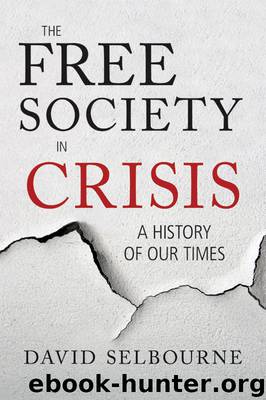
Author:David Selbourne
Language: eng
Format: epub
ISBN: 9781633885318
Publisher: Prometheus Books
Among the forces bestriding, building, and breaking down the civic order of free societies is one that Karl Marx came nearest to understanding. Like it or not—and market interest does not like it—he grasped, as none before, the nature of the Demiurge, the life force of “capital,” and comprehended how it makes, remakes, and unmakes the world, driving it to great heights of technical innovation and depths of self-destruction, as today. He also saw this Demiurge as itself driven by the constant need to “magnify and increase itself” in an “endless process” of expansion.1 It was an impetus that “gives capital no rest,” Marx wrote in 1847, but “continually whispers in its ear ‘Go on! Go on!’”2
This unrelenting pressure upon capital to increase has brought us the “world market,” the “globalization” of production at the Demiurge's dictation, immense cash reserves in the hands of great corporations, and the assumption that continuous “growth” is synonymous with “progress.” The same compulsion has generated new prospects and old hardships, recurrent economic crises, and gigantism which is often without redeeming content. It has also struck increasingly heavy ethical and cultural blows at the deformed social orders over which the Demiurge presides, and at the populations that comprise them. “In democracies,” thought de Tocqueville, observing the United States in the 1830s, “nothing is greater or more brilliant than commerce.”3 Marx in the following decade was arguably sager. “There can be too much industry, too much commerce,” he warned.4
For, in Marx's judgment, the Demiurge was an “unconscionable”5 force, allowing for few or no moral bounds and with its drive dependent on unrestraint. Culturally and ethically unanchored, it is nevertheless served in today's Western democracies by most of the political class, and it has the near-totalitarian power, exercised in freedom's name, to discredit and disallow alternatives to itself with relative ease. Roaring on in its cosmos of mobile capital, rapid technology transfer and “flexible” labor, the Demiurge's ideal is the “free-selling and buying”6 of everything under the sun at a global Vanity Fair, with “all nature explored in order to discover new useful qualities in things,”7 including now in the melting Arctic.
Recoil from such type of material ambition is again an ancient theme, and as old as moral thought itself. “There is nothing so harmful as money. It wins cities, chases men from their homes, and turns the minds of the honest to ill-doing,” Creon declares in Sophocles's Antigone.8 A similar type of criticism is implicit in de Tocqueville's description of the “spirit of gain” in the America of his day—with its puritan ethos already on the wane—as “always eager.”9 Indeed, the “love of wealth” was exaggeratedly claimed by him to be “at the bottom of all that the Americans do.”10 Another mid-nineteenth-century observer was still harsher, describing Americans as “tyrannized over” by a “very exacting and spirit-grinding ruler, Mammon.”11
But Marx's Demiurge of “capital” is a much grander force than that which drives mere cupidity. Striving to “tear down every barrier,”12 to “conquer the whole earth for
Download
This site does not store any files on its server. We only index and link to content provided by other sites. Please contact the content providers to delete copyright contents if any and email us, we'll remove relevant links or contents immediately.
| Anarchism | Communism & Socialism |
| Conservatism & Liberalism | Democracy |
| Fascism | Libertarianism |
| Nationalism | Radicalism |
| Utopian |
The Secret History by Donna Tartt(19088)
The Social Justice Warrior Handbook by Lisa De Pasquale(12190)
Thirteen Reasons Why by Jay Asher(8910)
This Is How You Lose Her by Junot Diaz(6887)
Weapons of Math Destruction by Cathy O'Neil(6280)
Zero to One by Peter Thiel(5802)
Beartown by Fredrik Backman(5754)
The Myth of the Strong Leader by Archie Brown(5508)
The Fire Next Time by James Baldwin(5446)
How Democracies Die by Steven Levitsky & Daniel Ziblatt(5219)
Promise Me, Dad by Joe Biden(5153)
Stone's Rules by Roger Stone(5088)
A Higher Loyalty: Truth, Lies, and Leadership by James Comey(4964)
100 Deadly Skills by Clint Emerson(4925)
Rise and Kill First by Ronen Bergman(4789)
Secrecy World by Jake Bernstein(4753)
The David Icke Guide to the Global Conspiracy (and how to end it) by David Icke(4720)
The Farm by Tom Rob Smith(4513)
The Doomsday Machine by Daniel Ellsberg(4490)
